What is Snowflake? Architecture & Features
In today’s data-driven world, organizations are constantly looking for faster, scalable, and cost-effective solutions to handle large volumes of data. Snowflake is one such cloud-based data warehousing platform that has revolutionized how businesses manage, analyze, and share their data. In this blog, we’ll dive deep into what Snowflake is, its architecture, and the features that make it a top choice for data professionals in 2025.
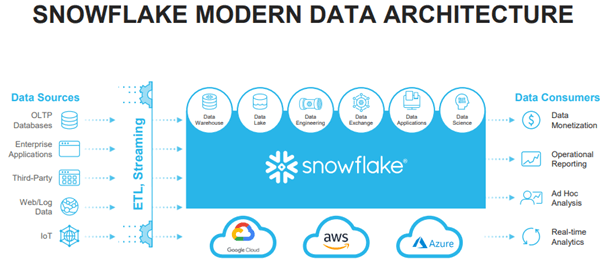
✅ What is Snowflake?
Snowflake is a fully managed, cloud-native data platform that provides data storage, processing, and analytic solutions across multiple clouds like AWS, Azure, and Google Cloud Platform (GCP). It allows users to run complex queries on structured and semi-structured data such as JSON, Avro, Parquet, and XML without worrying about infrastructure management.
Unlike traditional data warehouses, Snowflake’s architecture separates compute and storage, which provides better scalability, performance, and cost optimization.
📦 Snowflake Architecture Explained
Snowflake’s architecture is designed to handle modern data workloads with ease and efficiency. It can be divided into three key layers:
1️⃣ Database Storage Layer
This layer is where all the data is stored. Snowflake stores data in compressed, columnar format on cloud storage services like AWS S3, Azure Blob Storage, or Google Cloud Storage. This storage is optimized for fast retrieval and efficient usage. Data is automatically encrypted and backed up, ensuring security and reliability.
2️⃣ Compute Layer (Virtual Warehouses)
The compute layer consists of virtual warehouses, which are independent clusters of compute resources. These warehouses handle query processing and can be scaled up or down based on workload. Each user or department can run queries without impacting others, as multiple virtual warehouses operate independently.
- Auto-scaling and auto-suspend features allow cost optimization.
- Users can run multiple concurrent queries without resource contention.
3️⃣ Cloud Services Layer
This layer manages critical services such as:
- Authentication and security
- Metadata management
- Query optimization
- Infrastructure management
It ensures seamless interaction between users and the underlying architecture while abstracting the complexity.
🌟 Key Features of Snowflake
Here’s why Snowflake stands out in the data warehousing space:
✅ Separation of Compute and Storage
Unlike legacy solutions, Snowflake allows you to scale storage and compute independently. This flexibility enables users to pay only for the resources they use.
✅ Support for Structured and Semi-structured Data
Snowflake supports multiple data formats like JSON, Avro, Parquet, ORC, and XML. Users can query these datasets without needing complex transformations.
✅ Zero Management
There’s no need for manual tuning, indexing, or vacuuming. Snowflake takes care of maintenance, backup, and recovery automatically.
✅ Data Sharing
Snowflake’s Secure Data Sharing feature allows organizations to easily share live data across departments or with external partners without data duplication.
✅ Concurrency Handling
Multiple users can run queries simultaneously without resource conflicts, thanks to its unique architecture.
✅ Automatic Scaling
Compute resources can scale up during peak usage and scale down during idle times, reducing operational costs.
✅ Security & Governance
Snowflake offers encryption at rest and in transit, role-based access control (RBAC), and multi-factor authentication (MFA), making it enterprise-ready.
📈 Why Choose Snowflake?
- Performance: Optimized storage and fast query execution.
- Scalability: Easily handle growing data volumes.
- Cost-effective: Pay only for what you use.
- Ease of use: Minimal setup and maintenance.
- Collaboration: Share data securely and efficiently.
📌 Final Thoughts
Snowflake has become a go-to platform for businesses seeking a modern, cloud-first approach to data warehousing. Its architecture—designed for scalability, flexibility, and ease of use—combined with powerful features like automatic scaling, secure data sharing, and support for diverse data formats, makes it a top choice for enterprises across industries.
If you’re planning to work with data, or if your organization is seeking a reliable, high-performance data solution, Snowflake is definitely worth exploring.
Start leveraging Snowflake’s architecture and features today to unlock new insights and accelerate your data-driven decisions!